Cutting the cord doesn’t mean cutting yourself off from local news, sports, and prime-time favorites. A good indoor TV antenna lets you pull in free over-the-air channels like ABC, CBS, NBC, FOX, and PBS in crisp HD — or even 4K where your local stations broadcast it — without a single monthly bill. The catch is that not all antennas are created equal: range, amplification, cable length, and design all affect how many channels you’ll actually receive in your living room.
To help you cut through the noise, we rounded up five of the most popular indoor antennas on the market in 2026, from Channel Master’s no-frills flat panel to long-range amplified models built for homes farther from broadcast towers. Whether you live in a downtown apartment a few miles from the tower or out in the suburbs where every extra decibel of amplification counts, there’s an option below that fits your setup. Here’s a closer look at each one, based on their official product listings and specifications.
1. Channel Master FLATenna
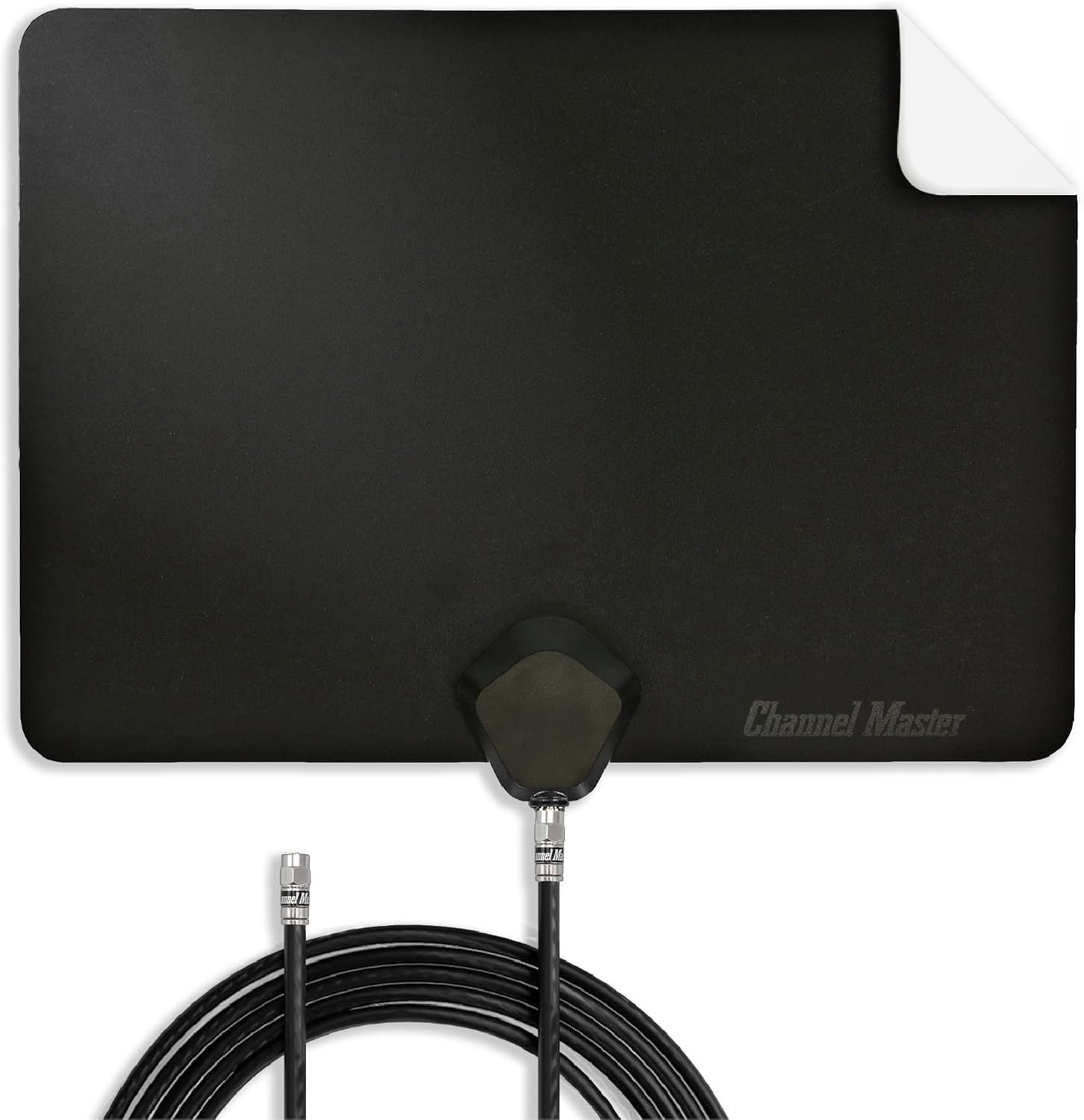
The Channel Master FLATenna is the antenna most often recommended for people who just want something that works without fuss. It’s a paper-thin, non-amplified panel antenna with a realistic 35-mile reception range, designed with real-world obstructions and interference in mind rather than the inflated “thousands of miles” claims common elsewhere in this category. It pulls in major networks — ABC, CBS, FOX, NBC, PBS, The CW, Univision, and Telemundo — completely free, and supports ATSC 3.0 NextGen TV as well as 4K broadcasts.
Its reversible black-and-white design lets it blend into almost any room, and it can be mounted on a wall, window, or simply laid flat on a tabletop. The box includes a 12-foot RG6 coaxial cable with enhanced shielding, adhesive mounting strips, and an instruction guide, so setup takes only a few minutes. Because it skips the amplifier entirely, there’s no power cord to manage and nothing to overload the signal in homes that are already close to broadcast towers. Backed by Channel Master, a manufacturer that has built antennas since 1949, the FLATenna is a dependable, no-amplifier pick for urban and suburban viewers who don’t need extreme range.
2. Qellaff Smart TV Antenna Indoor

Qellaff’s 2026 smart TV antenna takes the opposite approach: it’s built for homes that need serious amplification to reach distant towers. The listing advertises a 5000+ mile signal range figure (a marketing convention common to this style of antenna, meant to signal strong amplification rather than a literal distance), powered by an upgraded smart IC chip and 2026 filtering technology designed to reduce noise and interference. It supports a full range of formats, including 720p, 1080i, 1080p, 2K, and 4K HDR, and can pull in channels like ABC, CBS, NBC, PBS, FOX, Univision, and HSN at no cost.
The antenna is built for flexible placement both indoors and outdoors — living rooms, bedrooms, tabletops, windows, walls, roofs, RVs, and boats are all fair game thanks to its long, thick 38-foot coaxial cable. The full package includes the antenna unit, a signal booster amplifier with LNA, a high-shield coaxial cable, a USB power cable, a coaxial port adapter, mounting hardware, and double-sided adhesive tape. Qellaff also backs the product with 24-hour customer support for reception, installation, or performance issues, which is a useful safety net given how much setup and positioning can affect results with amplified antennas like this one.
3. JM NEXLOV Indoor TV Antenna
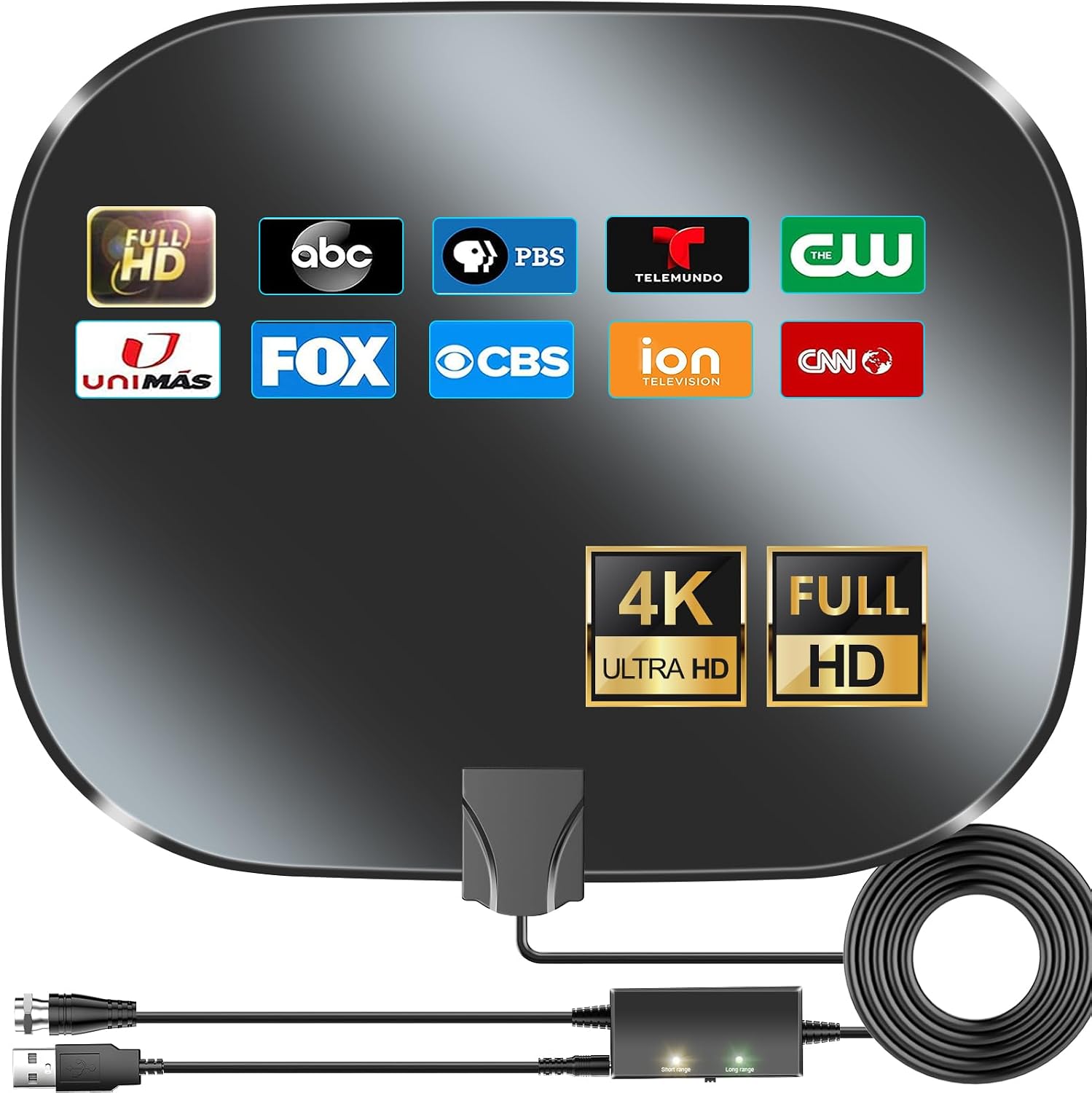
The JM NEXLOV indoor antenna is another amplified long-range model, aimed at users who want maximum flexibility in where they place it. Like the Qellaff model, it lists an aggressive “5000+ miles” range figure tied to its amplifier strength and 2026-updated smart IC chip, which is designed to filter out cellular and FM interference while boosting weak broadcast signals. It supports 4K, 8K, and 1080p resolutions, and can access free channels including ABC, CBS, NBC, PBS, and FOX.
Design-wise, the antenna has a flat, low-profile panel that can sit directly on a desktop, mount to a wall, or attach to a window, making it easy to fit into small apartments as well as larger homes. It ships with an 18-foot coaxial cable, giving you plenty of reach to position it near a window facing your local towers — often the single biggest factor in reception quality for any indoor antenna. The all-black finish is intended to blend into most home decor rather than standing out as obvious hardware. JM NEXLOV’s support team commits to a 24-hour response window for any installation or reception troubleshooting, which is helpful since amplified antennas typically need some trial-and-error repositioning and channel rescanning to hit their peak performance.
4. nelapsano Signal Booster TV Antenna

The nelapsano antenna is built around the idea that more amplification means more channels, advertising a 5000+ mile range backed by a powerful signal booster and 360-degree omnidirectional reception. It’s designed to work both indoors and outdoors, and the listing highlights compatibility with essentially all smart and older TVs, provided your set has a digital tuner. Supported channels include the usual free-to-air lineup — ABC, CBS, NBC, PBS, FOX, The CW, and Univision — delivered in 4K and 1080p picture quality.
One thing that sets this model apart is the emphasis on adjustable reception: the booster can be tuned to optimize for the best available signal in your specific location, rather than running at a single fixed amplification level. This can matter if you live somewhere with mixed signal conditions, such as a mix of nearby and distant towers. The antenna is intended for placement near a window or on a wall for the strongest results, and its reception is explicitly described as being affected by distance to towers and obstacles like buildings or trees — a reminder that, as with all indoor antennas, actual performance depends heavily on your specific location relative to broadcast towers.
5. FGOTV TV Antenna for Smart TV

The FGOTV indoor antenna takes a different physical approach with a compact cylindrical design, paired with a magnetic base and a wall-mount plate for flexible setup. Independent reviewers have highlighted its built-in signal booster with manual range switching, which lets you dial in amplification for distances up to roughly 250 miles rather than relying on a single fixed setting — a more grounded range claim than some competitors in this list. It supports both 4K and 1080p resolutions for a clear, modern picture on compatible smart TVs and other HDTV-tuner-equipped sets.
Because of its small footprint and magnetic mount, the FGOTV antenna is especially well suited to apartments, dorms, or anywhere you’d rather not deal with a large flat panel taking up wall space. As with any indoor antenna, real-world performance depends on placement — reviewers note that positioning it near a window or as high as possible, combined with a clear line toward local broadcast towers, produces the most consistent results. It’s rated as a strong option for households in suburban or urban areas within reasonable range of towers, though like other compact antennas it may need more careful positioning and occasional rescanning in tougher reception environments.
Conclusion
There’s no single “best” indoor antenna for every household — the right pick depends on how far you live from broadcast towers, how much amplification you need, and how much space you’re willing to dedicate to the antenna itself. If you’re close to towers and want the simplest possible setup, the non-amplified Channel Master FLATenna is hard to beat. If you’re farther out or live somewhere with more signal interference, the amplified long-range models from Qellaff, JM NEXLOV, and nelapsano give you adjustable boosters and generous cable lengths to chase down a stronger signal. And if space is tight or you just want a smaller, more discreet unit, the compact cylindrical FGOTV antenna with its magnetic base is worth a look.
Whichever model you choose, remember that placement matters just as much as specs: mounting your antenna near a window, as high as possible, and pointed toward your local towers will almost always outperform a technically “stronger” antenna stuffed in a closet. Use a tool like dtv.gov’s reception maps to check which towers and channels are actually available at your address, and always rescan for channels after repositioning. With the right antenna and a little trial and error, you can enjoy hundreds of hours of free local programming — no cable bill required.