Shortwave listening is still alive. Hobbyists chase international broadcasters, emergency planners want a radio that works when the grid doesn’t, and travelers want a pocket receiver that doesn’t depend on a phone signal. What has changed is the range of options. A pocket radio costs about the same as lunch, while a software-defined receiver shows you the spectrum on a waterfall display.
This list runs from five to one and covers very different kinds of buyer: the budget minimalist, the DX-focused hobbyist, the veteran who wants a classic, the emergency-prep shopper and the tinkerer who wants modern DSP. Each pick is judged on real specs and what owners and reviewers report, not on marketing copy. None of them is perfect, so each section also names the weak spot to watch for.
5. Qodosen DX-286

The DX-286 is a compact receiver built around the NXP TEF6686 chip. The listing quotes a signal-to-noise ratio of 60 dB or better across LW, AM, FM and shortwave. It measures about 13.4 x 3 x 7.6 cm and weighs 200 g, so it fits in a jacket pocket. The speaker is rated at 3 watts. It is powered by a rechargeable battery over USB.
Owners praise its sensitivity. One experienced listener wrote that it holds its own against, and sometimes beats, portables costing $200 to $300. The same reviewer pointed to the internal and external antenna switching as the key to good reception. The model had 4.5 stars from 130 reviews when I checked.
The limits are clear. A more critical owner noted that the shortwave bands stop at 27 MHz, there is no SSB, and strong signals can appear off their true frequency. That could be a problem where powerful stations are plentiful.
Best for: AM/FM-focused listeners who want a little shortwave and strong reception for the money. One buyer listed it at $89.99.
4. XHDATA D-221

The D-221 is for people who want a simple radio that works. It is based on the popular D-220 pocket radio, with a weather band added. Retailer listings describe it as an AM/FM/SW/NOAA receiver powered by two AA batteries. That makes it easy to keep in a go-bag, since you can swap in spare cells anywhere.
One reviewer called it a model of simplicity: a volume knob with power switch, a tuning knob and a band selector, with no extras. The same reviewer found that AM and FM worked very well, and that at night the AM dial pulls in stations 700 to 1,000 km away or more. The price is about $20.
Shortwave results are mixed. That reviewer’s sample showed mostly images (“birdies”) on shortwave and no clear reception. A buyer in another review said they picked up several shortwave stations on first use, including a Cuban station, without adding an antenna. Treat shortwave as a bonus.
Best for: emergency kits, gifts and first-time buyers who want analog-style controls and NOAA alerts at a very low price.
3. Sangean ATS-909X2

The ATS-909X2 is the veteran of this list, a second-generation version of a long-admired portable. It is a serious radio. It offers 1,674 presets, five tuning methods and an air band mode. The listings add 42 time zones with daylight saving and automatic tuning on LW, MW, SW and FM. One retailer lists shortwave coverage of 1.711 to 29.999 MHz and an air band of 118 to 137 MHz.
It is also large for a portable. The listing gives about 20.75 x 13.49 cm, around 725 g, and four AA batteries. The kit includes a roll-up SW antenna, headphones, a carrying case and a power supply.
Early units had problems. Reviewers reported severely reduced SSB audio, especially on LSB, plus excessive drift. Sangean released firmware updates, so check that any unit you buy is current. The price is steep, with one US dealer listing it at $349.95, down from $449.95.
Best for: enthusiasts who value a keypad, deep memory and a traditional feel over the cheapest price.
2. Greadio Portable Shortwave Radio
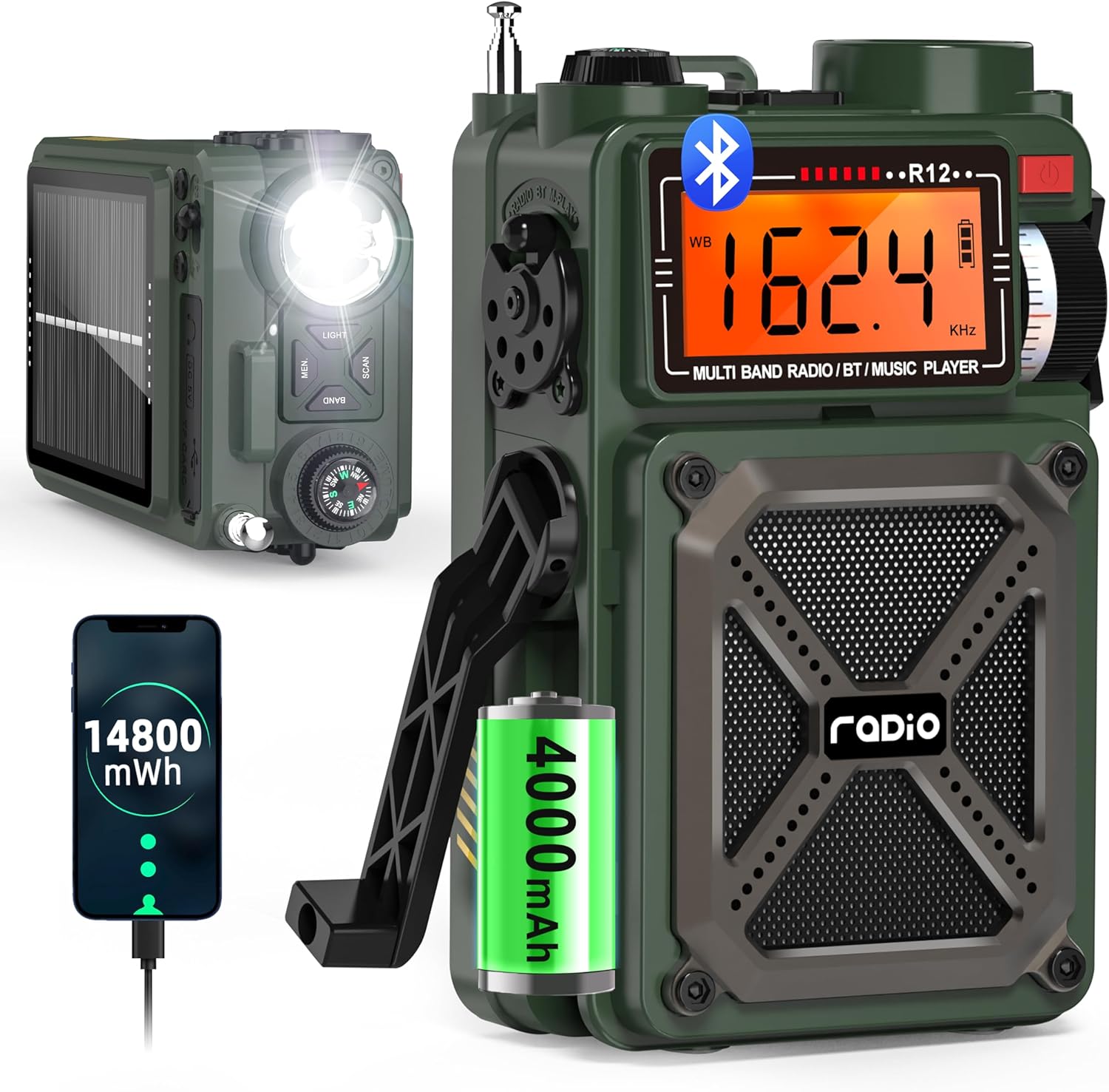
The Greadio is an emergency radio that happens to cover shortwave. A matching listing calls it a 12-in-1 radio with AM/FM, shortwave, NOAA weather, Bluetooth 5.4, USB and TF card playback, an SOS siren, a flashlight and a 14800mWh charger pack, with IPX3 water resistance. It lists four radio modes, three music modes and three charging methods: Type-C, solar and hand crank.
The crank and solar panel mean you can still hear weather warnings during an extended outage. The power bank can also top up a phone, and the Bluetooth and TF-card playback make it useful on an ordinary camping trip.
This is not a DX machine. Radios in this class usually trade tuning precision and selectivity for survival features, so expect decent reception on strong stations rather than weak distant ones. Since I couldn’t open your exact Amazon page, confirm the final specs on the listing itself.
Best for: storm-prone households, campers and preppers who want one device for alerts, light, charging and music.
1. Raddy MLite-880

The MLite-880 earns the top spot because it brings modern SDR techniques into a handheld. The maker’s listing describes a receiver covering LW, MW, SW, FM and airband, with AM, SSB (LSB/USB), CW, SAM, NFM and WFM modes, a waterfall spectrum display and a replaceable 5000mAh 21700 battery. The spectrum display lets you spot a weak carrier visually before you hear it.
One technical review explains the design: it uses an STM32H743 processor and shares DSP quality with the Malahit DSP2, but has a standard crystal oscillator instead of a TCXO. A hobbyist review also notes that it uses neither the Si4732 nor the TEF6686 chip. Expect a bit less frequency stability than the premium Malahit.
Coverage details need care. One tester noted that the literature advertises coverage to 148 MHz, though the radio can be tuned higher, for example to NOAA weather frequencies with NFM. That tester also described flashing the firmware back to an earlier version while sorting out problems, so keep the original firmware handy.
Best for: serious hobbyists who want SSB, CW and a live spectrum view without paying for a desktop SDR.
How to Choose
Match the radio to the way you listen. Decide first whether you need SSB, which is what lets you hear amateur and utility stations. Of this group, only the Sangean and the Raddy offer it. If you mostly want AM, FM and the occasional shortwave broadcaster, the Qodosen or XHDATA will serve you at a fraction of the cost.
Next, consider power. AA batteries (XHDATA, Sangean) are easy to replace anywhere, while rechargeable packs (Qodosen, Raddy, Greadio) are more convenient but depend on charging. Finally, a good antenna matters more than most people expect. A clip-on wire or a window loop will improve almost any of these radios.
Conclusion
There is no single best radio here, only a best fit. The Raddy MLite-880 is the most capable and forward-looking, and the Sangean ATS-909X2 is the polished traditional choice, as long as you buy a firmware-updated unit. The Qodosen DX-286 is the best value for strong AM and FM reception with some shortwave, and the XHDATA D-221 is the cheapest dependable option for a drawer or go-bag. The Greadio suits anyone who wants alerts, light and charging in one device first, with shortwave as a bonus.
Whichever you choose, buy from a seller with a clear return policy. Test the radio at night, when shortwave and AM propagation open up, and try it with an external antenna before judging it.